New search intent model, significant stability improvements & bug fixes ++
New search intent model
We’ve been focused on significantly enhancing our search intent classification. Four years ago, we were one of the few tools using a trained machine learning model to classify intent—well before OpenAI and other large language models (LLMs) emerged. Since then, we’ve dedicated considerable time to integrating LLMs alongside our own machine learning models, which are pre-trained on millions of SERPs. The result of that effort is the new model we’re launching today.
So, what’s new with this intent update?
-
We made our search intent classification much more accurate.
-
We’ve introduced a new intent type, ‘Commercial’
-
A new ‘Identify intent’ feature for the cluster head term.
We made our search intent classification much more accurate.
Our intent classification accuracy has seen a significant improvement and has been applied across the entire app, enhancing features like clustering, Briefs, Writer Assistant, and Title AI.
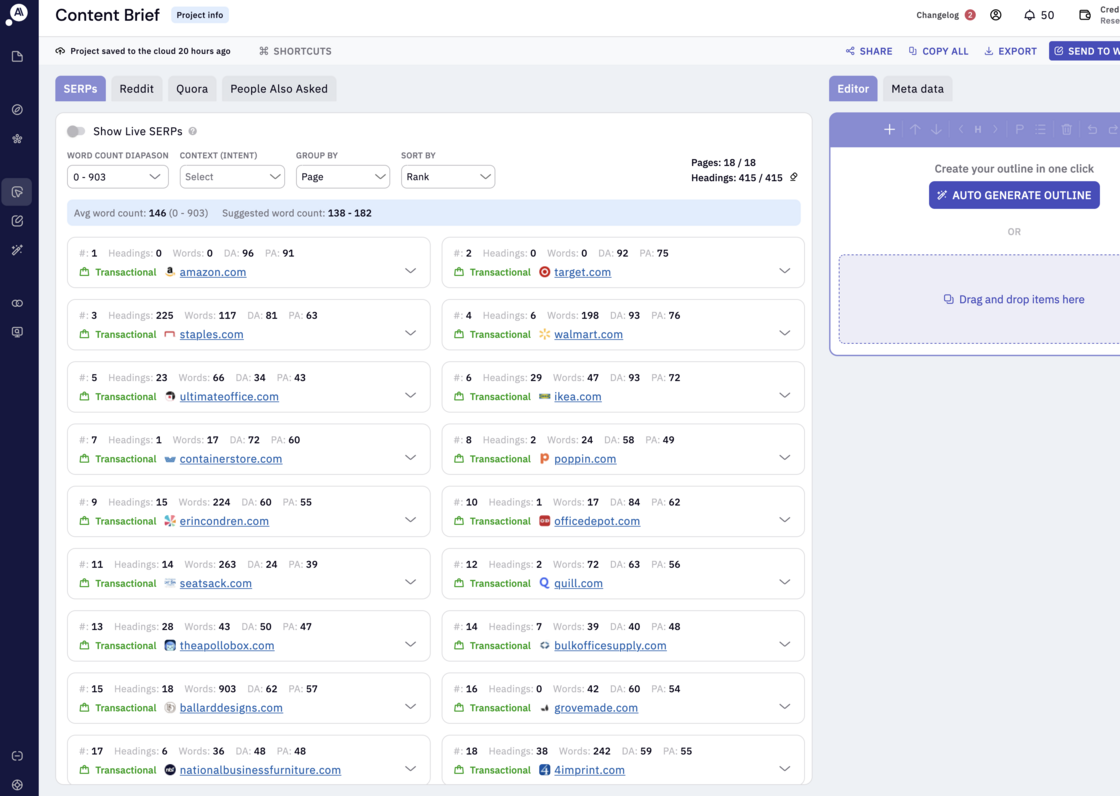
We’ve introduced a new intent type, ‘Commercial’
We’ve introduced a new intent type, ‘Commercial,’ bringing the total number of intent types to four.
We currently offer 4 types of intent classifications.
Informational - The user is looking for information or answers to a question. They aren’t necessarily looking to make a purchase but are seeking knowledge or insights. For example, a search like “how to improve SEO rankings” indicates informational intent.
Commercial - The user is interested in exploring products or services but hasn’t made a final decision yet. They may be comparing options or researching before making a purchase. For example, “best SEO tools” is a commercial intent query.
Transactional -The user is ready to take action, usually to make a purchase or complete a specific task. They’ve done their research and are now looking for a way to execute, such as “buy SEO software” or “buy cbd oil.” We usually classify product and product category pages.
Other - These are pages that don’t fall into any of the above. Usually a home page, terms and conditions etc.
A new ‘Identify intent’ feature for the cluster head term.
A new ‘Identify intent’ feature for the cluster head term
We analyze the top ten SERP results for the main cluster term to identify the intent distribution. This helps you determine the best type of content to create. By reviewing the ranking URLs alongside the intent, you can decide which type of page will be most effective for targeting that cluster.
Significant stability improvements to the application.
Recently, we experienced a surge in new customers, which led to some of our features slowing down or crashing intermittently. To address this, we’ve implemented several backup systems and stability optimizations to prevent these issues moving forward. We’re continuously working to enhance the app’s performance and reliability, and we truly appreciate your patience during this time.
We fixed multiple bugs.
-
Rankings in Clustering report now takes featured snippet URLs into consideration.
-
CSV upload not parsing numbers correctly when they are strings.
-
Public API clustering order does not create a folder.
-
Filtering issue causing some clusters to go ‘missing’.
-
The briefs progress not shown in the projects section.
-
API Improvements based on bug: Some customers cannot run clustering order via API calls.
-
Reddit Topics not getting pulled correctly in German.
-
Improved the AI content detection module in Writer assistant.